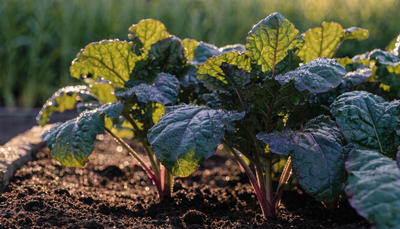
Beets are one of the most underestimated vegetables in the garden. You plant one seed and get two harvests — tender greens for the salad bowl and dense, earthy roots for roasting, pickling, or eating raw. They're a cool-season crop that tolerates light frost, making them ideal for spring and fall production, and with succession planting you can be pulling beets from the garden for months. The catch is that beets are a little more demanding than their reputation suggests. Get the soil wrong, skip thinning, or miss a trace mineral, and you'll end up with a row of leafy tops sitting above stunted, woody roots.
This guide covers everything you need to grow high-quality beets organically — from variety selection and soil prep through fertilizing, pest management, and harvest. Whether you're growing for roots, greens, or both, the fundamentals are the same: healthy living soil, consistent moisture, and a fertilizer program that supports both top and root development.
Choosing the Right Beet Varieties
Not all beets are the same, and variety selection matters for both flavor and purpose. Detroit Dark Red is the classic — reliable, productive, and excellent for both fresh eating and canning. Chioggia (candy-stripe) offers a milder flavor and striking interior pattern, though it loses the rings when cooked. Golden beets are sweeter, less earthy, and don't bleed — great for salads and roasting alongside other vegetables. Bull's Blood is grown primarily for its deep burgundy greens, which are among the most ornamental and flavorful of any beet variety.
For continuous harvest, pick two or three varieties with different maturity dates and stagger your sowings every 3–4 weeks. Most beets mature in 50–70 days, so a spring planting followed by a midsummer and early fall sowing will keep you harvesting until the ground freezes.
Soil Preparation for Organic Beets
Ideal Soil Conditions
Beets are a root crop, which means your soil texture is non-negotiable. Compacted, rocky, or clay-heavy soil will deform roots, stunt growth, and force the plant to put energy into fighting its environment instead of building a bulb. Aim for a loose, deep, well-draining loam with a pH between 6.0 and 7.0. Anything below 6.0 makes boron and other micronutrients unavailable — and boron is particularly critical for beets.
Till or loosen the bed to at least 12 inches deep. Remove rocks and break up clods. Beets don't need extremely rich soil — excess nitrogen drives lush leafy growth at the expense of root development — but they do need a balanced, mineral-rich environment with good structure.
Building Living Soil
Incorporate 2–3 inches of finished compost into the top 6–8 inches of your bed before planting. This improves both drainage and moisture retention while feeding the microbial community that makes nutrients available to your plants. A living soil is especially important for beets because phosphorus uptake — which directly drives root size and density — depends heavily on microbial activity near the root zone.
Inoculating with beneficial microbes at transplant or direct sow time dramatically improves phosphorus mobilization in organic systems. Growganica MICROBES introduces the beneficial bacteria and fungi that colonize the root zone and unlock soil-bound phosphorus, making it available exactly when the developing beet root needs it most. Apply to the soil at bed preparation or water in at first irrigation.
Planting Beets: Timing and Technique
Beets are direct-seeded — they don't transplant well due to tap root sensitivity. Sow seeds ½ inch deep, spacing them 1 inch apart in rows 12 inches apart. What looks like a single beet seed is actually a cluster of 2–4 seeds fused together, which means nearly every "seed" you plant will produce multiple seedlings.
For spring planting, sow 4–6 weeks before your last frost date. Soil temperature should be at least 45°F, though germination is faster and more uniform at 55–65°F. For fall, count back 8–10 weeks from your first expected frost. Fall-grown beets are often sweeter — cold weather converts starches to sugars in the root.
Keep the seedbed consistently moist until germination (7–14 days). A light mulch layer helps retain moisture without crusting over the soil surface.
Thin aggressively. This is the step most growers skip, and it's why they end up with small, deformed roots. When seedlings reach 2 inches tall, thin to one plant every 3–4 inches. When they hit 4–5 inches, thin again to one plant every 6 inches. The thinnings are edible — use them as microgreens or in salads. Crowded beets compete for nutrients and space; they will never size up properly no matter how well you fertilize.
Watering Beets Organically
Beets need consistent moisture throughout the growing season. Irregular watering — wet then dry, wet then dry — causes root cracking, tough texture, and a bitter, pithy interior. Aim for 1 inch of water per week, adjusted for heat and rainfall. Drip irrigation is ideal because it delivers moisture directly to the root zone without wetting foliage, which reduces disease pressure.
Mulching with straw or wood chips after thinning conserves soil moisture, regulates temperature, and suppresses weeds. Keep mulch pulled back slightly from the crown of the plant to prevent rot.
Organic Fertilizing Schedule for Beets
Beets need a fertilizer program that serves two different purposes at two different growth stages: feeding the leafy top growth early on, then shifting to root development and sizing as the plant matures. Feeding the wrong thing at the wrong time is as bad as not feeding at all.
At planting and through the first 3–4 weeks: If you're growing beets primarily for their greens, or want strong top growth before the root begins to bulb, incorporate Growganica GOLD VEG into your base feeding program. Its nitrogen-forward, balanced formula supports healthy leaf development and gives the plant the energy it needs to establish before directing resources downward.
From weeks 4–5 through harvest: Once the root begins to develop, shift your focus to phosphorus and potassium. This is when Growganica SEAPHOOD earns its place in the beet garden. SEAPHOOD's phosphorus-rich marine blend directly supports root cell development, bulb expansion, and the dense, smooth texture that separates a great beet from a mediocre one. Apply every 1–2 weeks during the root-filling phase.
Trace minerals — especially boron: Boron is the most critical micronutrient for beet quality, and it's the most commonly overlooked. Boron deficiency causes crown rust (dark lesions on the top of the root), internal browning, and hollow beets with a corky texture. Symptoms show up late, when the damage is already done. Growganica KELP IT REAL delivers a full spectrum of trace minerals including boron, sourced from cold-pressed kelp. Apply every 2 weeks as a foliar spray or soil drench throughout the season. Prevention is the only strategy with boron — once you see crown rust, the affected roots cannot be recovered.
Organic Pest and Disease Management
Beets are relatively pest-resistant, but a few problems are worth knowing. Leaf miners are the most common insect pest — the larvae tunnel between leaf surfaces, creating pale, winding trails. Remove and destroy affected leaves immediately. Row cover applied at planting prevents adults from laying eggs. Flea beetles create small holes in young leaves; they're mainly cosmetic and rarely severe enough to warrant intervention beyond row cover for transplants.
Cercospora leaf spot appears as circular tan spots with a purple border on older leaves. It's common in humid weather and worsens with overhead watering. Remove affected leaves, improve air circulation, and switch to drip irrigation. Avoid working around plants when foliage is wet. Organic copper sprays can help in severe cases.
Damping off affects seedlings in cold, wet conditions. Ensure good drainage, don't overwater, and plant into soil that's warm enough for germination.
Harvesting Beets
Most beet varieties are ready to harvest when roots reach 1.5–3 inches in diameter — roughly the size of a golf ball to a tennis ball. Bigger isn't always better; roots beyond 3 inches often become woody and less flavorful. You can harvest a few roots early at golf-ball size for tenderness, then continue pulling as needed.
To harvest, grasp the greens near the base and pull firmly while loosening the soil with a fork. Trim greens to 1 inch above the root (leaving them intact prevents the root from "bleeding" in storage). Roots store well in a cool, humid environment — refrigerator crisper, root cellar, or damp sand — for 2–4 weeks.
Beet greens are highly perishable and should be used within 2–3 days of harvest. They're best sautéed with garlic, used raw in salads when young, or treated like chard in any cooked preparation.
Common Problems and Troubleshooting
Small, stunted roots: Almost always caused by overcrowding. Thin to 6 inches between plants. Also check soil compaction — roots cannot size up in hard soil.
Hollow or corky interior: Classic boron deficiency. Apply KELP IT REAL immediately and preventively in future seasons.
Crown rust (dark lesions on root top): Boron deficiency again. Also check soil pH — boron becomes unavailable below 6.0.
Cracked or zoned roots: Irregular watering. Mulch and maintain consistent soil moisture.
Bitter, tough roots: Harvest too late, or stressed by heat. Grow beets in cool weather and harvest on time.
Leggy tops, no root development: Too much nitrogen, not enough phosphorus. Adjust fertilizer program — reduce nitrogen-heavy inputs, add SEAPHOOD.
Poor germination: Soil crust prevents emergence. Keep seedbed moist, use a light mulch, and pre-soak seeds for 1–2 hours before planting to improve germination rates.
Frequently Asked Questions
- Can you eat beet greens?
- Yes — beet greens are entirely edible and nutritious. Young leaves are excellent raw in salads; larger leaves can be sautéed, steamed, or used anywhere you'd use chard or spinach. If growing for greens, harvest outer leaves throughout the season and the root will continue to develop.
- Why are my beet roots small even though the plants look healthy?
- Overcrowding is the most common cause. Beets need 6 inches of spacing between plants to size up properly. If you skipped thinning or thinned late, the roots will stay small. Also check for soil compaction — roots can't expand in hard soil regardless of nutrition.
- What causes hollow or corky beets?
- Boron deficiency. It's the number-one micronutrient issue in beet production and is easily prevented with a kelp-based supplement like KELP IT REAL applied every two weeks through the season. Once visible, the damage cannot be reversed — prevention is critical.
- When is the best time to plant beets?
- Beets are a cool-season crop. Plant in early spring (4–6 weeks before last frost) and again in midsummer for a fall harvest. Fall-grown beets are often sweeter. Avoid planting when daytime temperatures consistently exceed 85°F — heat causes bolting and poor root quality.
- How long do beets take to mature?
- Most varieties mature in 50–70 days from direct sowing, depending on variety and growing conditions. Harvest when roots reach 1.5–3 inches in diameter for best texture and flavor.